
Wall art for a home library should give the eye somewhere to rest. Books already bring colour, pattern and fine detail, so the strongest photography is usually clear, spacious and easy to return to between pages.
Start with the room, not the subject
A home library can mean a wall of built-in shelves, a study with several bookcases or one reading chair beside a modest collection. The useful wall is different in each room.
Stand at the doorway, then sit where you normally read. Notice which bare surface holds your attention. It may be above a low bookcase, beside the chair or opposite the shelves. That is a better place to begin than the narrow gaps left between rows of books.
Bookshelves already create a grid. Adding several small frames around them can turn that grid into clutter. One considered photograph often gives the room a calmer centre.
Let the photograph contrast with the books
A full bookshelf contains dozens of colours, titles and vertical lines. The art does not need to repeat all of that information.
For a busy wall of books
Choose open sky, mist, water or a distant horizon. Negative space gives the eye a pause without making the room feel empty.
For simple built-in shelving
Architecture can echo the clean rhythm of the shelves. Look for one clear subject, repeated forms or a controlled black-and-white composition.
For a darker reading room
Use a photograph with a readable highlight or pale area. Deep shadow can feel atmospheric, but the image still needs enough separation to hold its shape in evening light.
Choose scale from the reading distance
A print above a chair or small side table will usually be viewed closely. It can be modest in size if the composition stays clear and the frame has enough breathing room.
An open wall opposite the shelves has a different job. It may need one larger image that can be read from across the room. Test the outer frame size with paper before making holes. Include the mount and frame, not only the printed photograph.
If the room only has a small patch of wall beside a lamp or bookcase, the guide to using small photography prints in quiet corners is the better next step.
Do not fill every gap in the shelving
Leaning a small framed print among books can work when the shelf is deep, stable and not already crowded. It should remain an exception rather than a pattern repeated in every section.
Keep the frame clear of books that are removed often. Avoid placing it where it can be knocked while reaching for a volume. If the artwork looks trapped between objects, move it to the wall and let both the books and photograph breathe.
A home library feels collected because the choices have room around them, not because every available surface is occupied.
Check lamps, windows and glare
Reading rooms often combine a task lamp with softer evening light. View the proposed position during the day and again with the lamp on.
If a bright reflection sits across the main subject, change the angle or position before changing the photograph. A print above a desk may catch light differently when you are seated. A picture beside a window can look balanced in the morning and disappear later.
The guide to lighting photography wall art covers picture lights, glare and colour in more detail.
Choose a frame that belongs to the room
Match the frame to the architecture and furniture rather than to one row of book jackets. Oak can soften a room with warm timber and older shelving. Black can give pale walls and modern joinery a cleaner edge.
A mount helps separate a detailed photograph from the visual texture of the books. It also makes a smaller print feel intentional rather than tucked into a spare patch of wall.
If you are deciding between frame finishes and presentation styles, read the guide to choosing framed photography prints for your home.
Avoid the obvious library theme
A reading room does not need photographs of books, typewriters or quotations to explain its purpose. The shelves already do that.
Choose an image that changes the pace of the room instead. A landscape can open the wall beyond the books. Architecture can introduce a stronger sense of order. A city at dusk can make an evening reading space feel more atmospheric without becoming themed decoration.
Use the seated-view test
Before buying or hanging the print, place a paper template on the wall and sit down with a book. Look up naturally rather than turning to inspect the arrangement.
Can you read the main shape without effort? Does the frame feel connected to the chair, desk or bookcase? Is there enough empty wall around it? Most placement problems become obvious from the position where the room is actually used.
Two quiet directions for a home library
These photographs solve different problems. One adds distance and softer natural colour. The other gives the room a clear architectural focal point.

Three Olive Trees
Soft greens, mist and open distance for a book-filled room that needs a quieter visual pause.
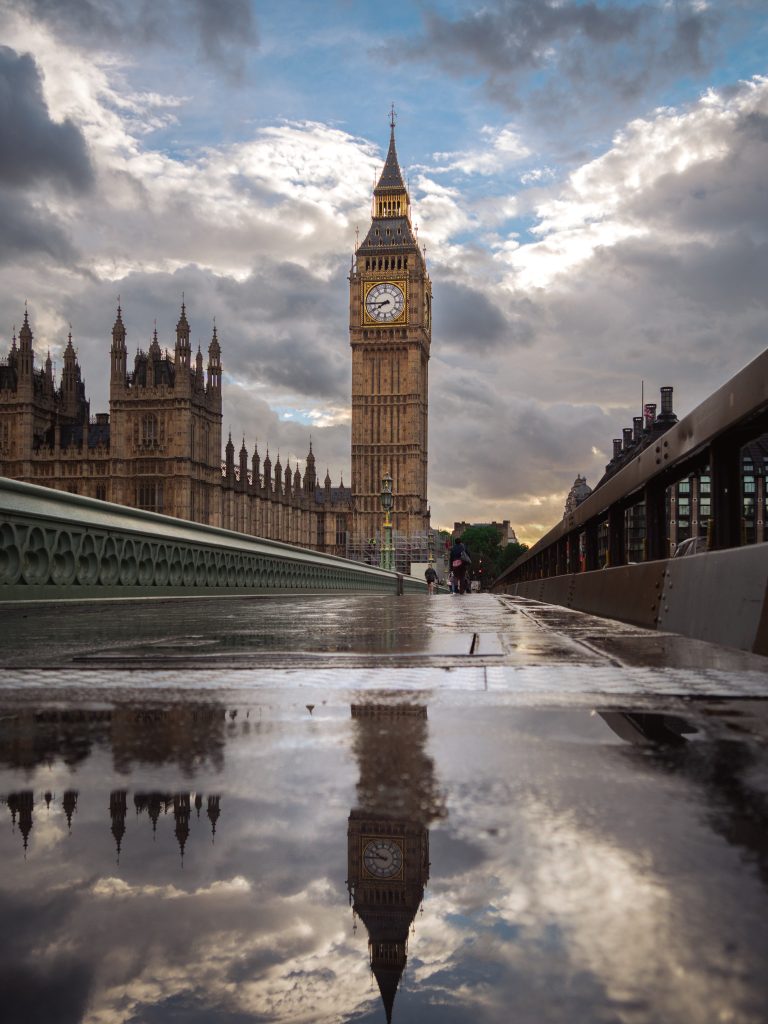
Big Ben After Rain
A strong vertical subject and restrained reflections for a library wall that needs structure beside low shelving.
Give the books some space
The best library wall art does not compete with the collection. It gives the room one clear place to pause.