
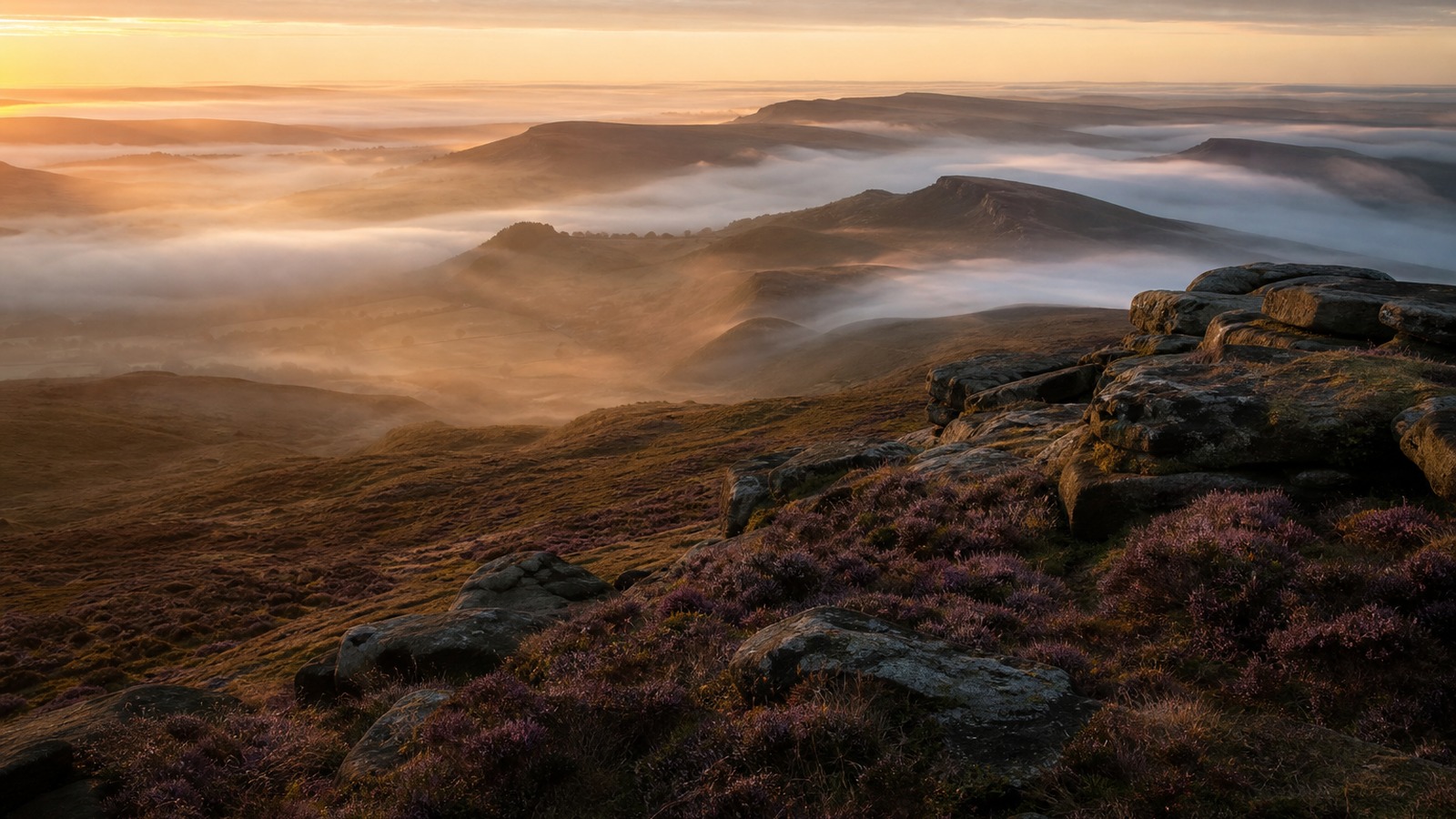
The Peak District gets underestimated. That is exactly why it rewards photographers who arrive before everyone else.
The Peak District gets underestimated.
Photographers talk about Scotland. The Lake District. Northumberland. Iceland if they want to sound serious.
The Peak District gets treated like the convenient option. The place you go when you cannot justify the longer drive.
That is a mistake.
For landscape photography, the Peak District has something many bigger locations do not: access, mood, and weather that changes quickly enough to reward patience. You can leave in darkness, stand on a ridge before sunrise, and watch the whole landscape rearrange itself in twenty minutes.
That is where the best images happen.
Not at midday. Not from the car park. Not when everyone else has arrived with a coffee and a phone.
Before that.
Why the Peak District works so well for landscape photography
The Peak District is split between two very different characters.
The Dark Peak is gritstone, moorland, ridges and reservoirs. It feels heavier. More dramatic. The weather sits on it differently. Mist collects in the valleys. Cloud moves fast over the edges. The light can go from flat to ridiculous without much warning.
The White Peak is softer. Limestone valleys. Rivers. Woodland. Villages. It gives you quieter images. Less drama, more texture.
For prints, both work. But the Dark Peak is where the strongest wall art usually comes from.
It has shape. Contrast. Empty space. The sort of image that still holds up when it is printed large.
Mam Tor, Hope Valley
Mam Tor is the obvious one because it deserves to be.
The ridgeline running toward Hollins Cross gives you a clean leading line. The Hope Valley drops away on one side. Edale sits on the other. In the right conditions, low cloud fills the valley and the ridge looks like it is floating.
That is the image everyone wants.
But the work happens before the view.
The best Mam Tor photographs usually start with a stupid alarm. 3:30 AM. Maybe earlier in summer. A dark walk from Mam Nick. A head torch. Wind. Waiting on the ridge while nothing happens.
Then, sometimes, the cloud breaks.
Twenty minutes of light. Maybe less.
That is enough.
Best conditions: October to March, especially after cold nights with low wind. Cloud inversions are most likely when the valley is cold and still but the ridge sits above the mist.
Best composition: Look south along the ridgeline for the classic line. If mist fills the Hope Valley, turn east and let the cloud carry the frame.
Print potential: Very high. Mam Tor works especially well as a wide landscape print because the ridge gives the image structure.
Ladybower Reservoir
Ladybower is different.
It is not wild in the same way Mam Tor is wild. It is managed, shaped, human-made. But before dawn, when the water is still, it becomes quiet in a way that photographs beautifully.
The reservoir gives you reflections. Dark water. Tree lines. Mist rising from the surface. The plughole overflow towers add something graphic and strange when the water level is high.
This is where you go when the sky is not dramatic enough for the ridges.
A flat morning can still work at Ladybower because the water carries the image.
Best conditions: Still mornings, especially autumn and winter. Wind ruins the reflection. Low mist helps.
Best composition: Water-level images looking across the reservoir toward Win Hill. Use the curve of the bank to pull the viewer through the frame.
Print potential: Strong for calmer rooms. Ladybower images work well in bedrooms, studies and spaces where you want stillness rather than drama.
Stanage Edge
Stanage Edge is one of the best places in England for simple, strong landscape photographs.
A long gritstone escarpment. Open sky. Rough rock. A drop into the valley. It does not need much decoration.
At sunrise, the eastern face catches light cleanly. In winter, frost on the gritstone can make the whole edge look sharper. In summer, the early start is brutal, but the first light over the moor is worth it.
The mistake at Stanage is trying to photograph everything.
The stronger images are usually simpler. One rock. One line of edge. One figure for scale. One clean sky.
Best conditions: Clear winter mornings, autumn light, or summer sunrise if you are willing to be there before most people are awake.
Best composition: Work along the edge rather than shooting the obvious viewpoint. The less-used sections often give cleaner frames.
Print potential: Excellent for black and white. The texture of gritstone prints beautifully when the light is low.
Higger Tor and Carl Wark
Higger Tor and Carl Wark reward slower photography.
They are not one-shot locations. They are places to walk, stop, turn around, and notice smaller frames. Gritstone boulders. Heather. Low ridges. Weather moving through Burbage Valley.
In late summer, when the heather is out, the colour can be strong. But the best images still need restraint. Too much colour can make a landscape feel decorative rather than lasting.
The better frame is often colder. More muted. A bit less obvious.
That tends to be the image you still want on a wall five years later.
Best conditions: Late summer for heather, autumn for low light, winter for structure.
Best composition: Use gritstone as foreground. Let the valley sit quietly behind it.
Print potential: Strong for atmospheric landscape prints, especially in muted colour palettes.
What the Peak District teaches you
The Peak District rewards showing up early.
Not because early starts are romantic. They are not. They are cold, inconvenient, and usually involve wondering why you do this to yourself.
But the landscape is different before the day begins.
No crowds. Less wind. Better water. Lower light. More mist. More chance of a frame that feels like it belongs to you rather than everyone.
That is the difference between a record shot and a photograph worth printing.
The camera matters less than the decision to be there.
Peak District prints from The Other Variant
For this article, the closest fit in the current shop is the Nature collection: quiet landscape prints with space, atmosphere and muted colour that suit calm interiors.